
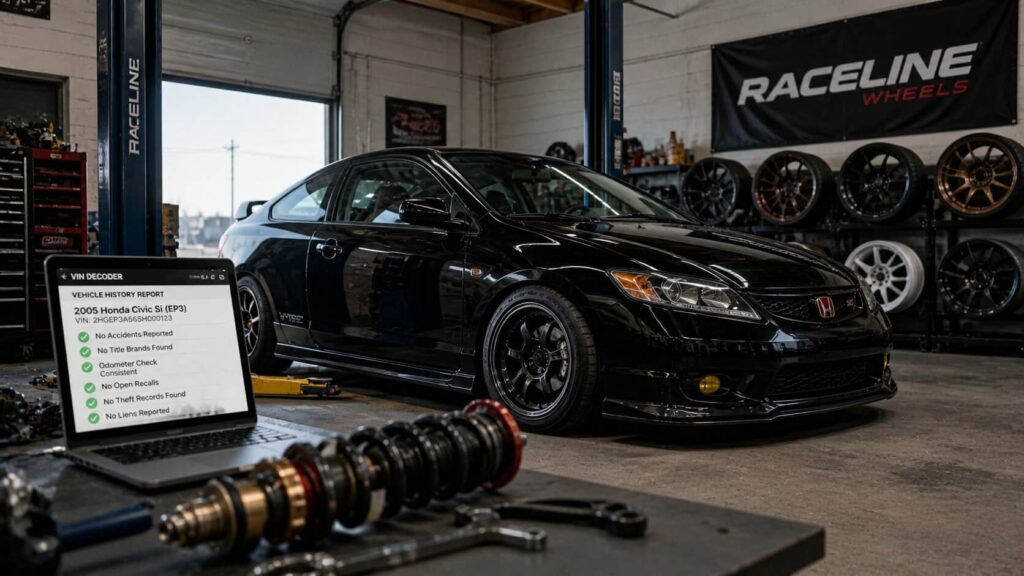
Why Every Civic Build Needs to Start With the VIN, Not the Parts Catalog
Here’s one example: A Civic comes in, looking sharp on Volk TE37s, partially done K-series swap, and Carfax printout waving in the air. Meanwhile, the first hour on the alignment rack reveals rear toe that is six millimeters out and right front strut tower movement under load. No matter how many aftermarket parts you add after this point, you are fighting with this chassis geometry until you replace a good chunk of the bodywork.
The story repeats itself in many tuner shops. This is one of the reasons why the approach to a typical build needs to include VIN check of the car. It allows seeing the true chassis history without spending extra dollars on suspension and wheels inspection or having the owner bring in his receipts to justify some weird mileage.
What Information a VIN Check Can Reveal About a Civic Chassis
There are different chassis models that Honda released during multiple generations, so every car had unique rust spots, accident profile, and resale characteristics. The VIN decoder will provide relevant information about the particular chassis without having to spend time inspecting every car. Running a Honda Civic VIN check free of cost returns the following information about the vehicle:
- Title brand in all US states;
- Odometer readings at the time of each registration or inspection;
- Any recalls on the chassis from Honda’s database;
- Salvage and insurance write-off information;
- Photos from auctions like Copart and IAA if the car was ever in their possession.
This is not an exhaustive list, but it includes the basic information that you may use when making your decision.
Where Hidden Accident Damage Ruins Performance Build
First, suspension geometry on Civic chassis is highly sensitive to unibody damage. One rear-quarter hit can put the subframe mounting points of EK and EP3 chassis out of spec in a way that is difficult to notice without a special tool. On stock suspension, the car will drive straight and even, and there will be nothing wrong with tires. The moment the owner installs aftermarket coilovers with adjustable camber arms, however, he will face the reality when rear toe is not possible to adjust.
Similarly, a big brake upgrade for the front of the car will result in a warping rotor and uneven pads. The fact is that a Brembo GT kit assumes certain positions of the strut towers and lower control arm pickups in relation to the steering knuckle. When one of the towers moves even by 4 millimeters because of a frontal hit, the entire setup will change and result in premature wear and tear. Customer blames the kit.
The same applies to engine rebuild. When you plan to install K-series engine into an existing chassis, you are assuming that mounting points on both ends remain untouched by accident damage. But if there was a frontal collision, then the mounting points become loose at three-thousand miles. It’s too late for any kind of rebuild and means replacement of the entire chassis.
How to Avoid Mileage Fraud on a Honda Civic
The problem with mileage rollbacks on Honda Civics has not gone away. Older generations were easy to tamper with thanks to mechanical cluster; newer FA5 and FK8 Type Rs are easier to fool with the help of specialized tools that reprogram digital cluster and make it display lower number of miles. NHTSA estimated that the number of vehicles with rolled back odometers is above 450 thousand per year in the United States alone. So when you see a nice-looking FA5 or FG2 showing 78 thousand miles, chances are it has already passed over 180 thousand.
It’s important for your workshop because mileage determines which engine or transmission parts you will be installing in the future. If the chassis has only 95 thousand miles on the odometer, then a simple bolt-on tune on D16 will do the trick. On the contrary, an engine with 220 thousand will start developing oil consumption, ring blow-by, and head gasket leaks just a few days after installation of the turbocharger.
Conclusion
Mileage history is one of the information categories revealed during a VIN check of a Honda Civic. You will be able to see odometer readings at the time of each registration or inspection procedure. If there is a suspicious dip between two mileage data points, then there is likely to be some form of fraud involved.
VIN check is cheap and quick way to get reliable information that could save you time, effort, and money in the future.